
Deck Paint vs Deck Stain for CT Shoreline Homes: Which Protects Better Against Coastal Weather
For Madison, Guilford, Branford, and Old Saybrook homes, where Connecticut's 48 inches of annual rainfall combined with salt air exposure on coastal properties accelerates wood moisture cycling, these signs tend to appear sooner and progress faster than they would on an inland property in a drier climate.
When Repair Is the Right Call
Repair makes sense when:
Most homeowners on the Connecticut Shoreline approach the deck paint vs stain decision the same way: they pick the color they want and choose the product that matches it. The finish looks good for a season or two. Then the peeling starts, or the boards start going gray, or the paint begins to blister in sections, and they are back at the beginning wondering what went wrong.
What went wrong is almost always the same thing. The product was selected for appearance rather than for what it does to the wood underneath in a coastal environment. And on a deck in Madison, Guilford, Branford, Clinton, or Old Saybrook, where salt air, freeze-thaw cycling, humidity, and direct UV exposure are all operating simultaneously, the way a finish interacts with the wood matters more than it does on an inland property where the stressors are milder.
Timber and Brush is an exterior wood repair and painting specialist based in Madison, CT. The team works on decks across the Connecticut Shoreline regularly, repairing boards that have been compromised by moisture trapped beneath a failed film finish and refinishing surfaces with the right product for the specific conditions these properties face. This is the comparison that determines which approach belongs on a CT Shoreline deck.
How Each Product Works and Why the Mechanism Matters
The reason deck paint and deck stain produce different long-term outcomes on Connecticut Shoreline properties is not about brand or price point. It is about the mechanism by which each product protects wood.
Deck stain penetrates the wood fibers.
A quality penetrating deck stain carries pigment, UV inhibitors, and water repellents into the cellular structure of the wood rather than sitting on top of it. The wood can still expand and contract as temperature and moisture conditions change because the finish is inside the wood rather than forming a layer over it. When the wood moves, the finish moves with it. Stain does not peel or chip because there is no film to detach from the surface.
Deck paint forms a film on the surface.
Paint builds a protective layer on top of the wood that blocks moisture and UV from reaching the wood below. When that film is intact, it provides strong protection. When the film cracks, when wood movement from freeze-thaw expansion and contraction opens a gap, moisture enters the space between the film and the wood and becomes trapped there. That trapped moisture is what drives rot in painted deck boards. The wood below the paint can be actively deteriorating while the surface still appears intact.
The USDA Forest Service Forest Products Laboratory, which is the primary government research institution on wood finishes and durability, states directly in its guidance on wood deck finishes that penetrating finishes are recommended for use on wood decks, and that film-forming finishes such as paints and solid-color stains are prone to trap moisture and fail by peeling. That guidance reflects the same dynamic that Timber and Brush encounters on painted decks throughout Madison, Guilford, and the surrounding Shoreline communities: by the time the paint is visibly failing, the wood underneath has often been holding moisture for a season or longer.
Why CT Shoreline Conditions Accelerate Paint Film Failure
The mechanism that causes paint to trap moisture operates on every painted deck in any climate. On a Connecticut Shoreline property, that mechanism is accelerated by conditions specific to this coastal environment.
Freeze-thaw cycling.
Connecticut experiences repeated freeze-thaw cycles through the winter, with temperatures crossing above and below freezing multiple times during a single week in the Madison and Guilford area. Each freeze-thaw cycle causes wood to expand as moisture freezes inside the fibers and contract as it thaws. A film-forming finish applied over that expanding and contracting substrate develops micro-cracks over successive cycles. Each crack is an entry point for moisture during the next rain or snow event. On a CT Shoreline property, this cycling occurs dozens of times between November and March.
Salt air.
Salt particles carried inland from Long Island Sound on prevailing onshore winds are hygroscopic, meaning they attract and hold moisture from the surrounding air against any surface they settle on. On a painted deck surface, salt particle accumulation between cleaning cycles keeps the film surface in contact with elevated moisture levels more consistently than an inland property would experience. Salt also accelerates the degradation of paint binders over time, reducing adhesion between the film and the wood below.
47 inches of annual rainfall.
The NOAA Connecticut State Climate Summary documents Connecticut averaging 47.3 inches of precipitation per year with no meaningful dry season. A painted deck on a Madison or Branford property cycles between wet and dry conditions year-round, and each wet period that reaches any micro-crack in the film introduces moisture to the wood beneath it.
UV intensity.
Connecticut Shoreline decks facing south or southwest, which is common on properties oriented toward Long Island Sound, receive high cumulative UV hours through the summer months. UV degrades paint film binders over time, reducing elasticity and making the film more prone to cracking under wood movement. A painted deck that begins to show fine checking in the surface has already lost the elasticity that allowed it to move with the wood through temperature cycles.
The Problem with Paint on a Previously Stained Deck
One of the most consistent situations Timber and Brush encounters on Shoreline deck jobs is a homeowner who switched from stain to paint at some point in the deck's history and is now dealing with the consequences.
A deck that has been stained accumulates stain residue in the wood fibers over years and multiple refinishing cycles. Paint applied over that stained wood cannot fully bond to the wood surface because the stain already occupies the upper fiber layer. The result is a paint film with reduced adhesion that fails ahead of the normal schedule and in a pattern that is difficult to repair because the underlying stain is not fully removable without significant preparation work.
On a CT Shoreline deck in Madison or Old Saybrook that was stained for its first several years, switching to paint typically requires a level of surface preparation, including stripping and sanding back to bare wood, that most homeowners and many painters do not budget for. Paint applied over inadequately prepared stained wood on a coastal property in Connecticut is a short-term finish that will look worse sooner than either a properly applied paint or a properly applied stain would have.
When Paint Is the Right Choice on a CT Shoreline Deck
Paint is not the wrong answer for every situation on a Connecticut Shoreline deck. There are specific circumstances where paint is the more appropriate specification and where Timber and Brush will recommend it.
Severely weathered or damaged boards where the wood appearance needs to be hidden.
A deck with boards that have gone significantly gray, developed deep checking from weathering, or have inconsistent appearance from years of uneven staining is a candidate for paint because paint conceals surface variation in a way that stain cannot. If the boards are structurally sound but visually compromised, paint can restore a consistent, clean appearance that stain applied to weathered wood will not achieve.
Decks where the prior history is paint and the commitment to maintenance repainting is present.
A deck that has been painted for its full history, where the existing film is still adhering well and the wood below it is sound, is a reasonable candidate for repainting when it reaches the end of its service life. The commitment required is to inspect and address any areas where the film has cracked or peeled before moisture reaches the wood, and to repaint on the schedule the product requires rather than deferring until visible failure occurs.
Railings and vertical surfaces.
The USDA Forest Service guidance specifically notes that railings and vertical surfaces can be finished with paint more successfully than deck boards because they do not face the same level of moisture accumulation and abrasion from foot traffic. On a CT Shoreline deck where the homeowner wants stain on the horizontal deck boards and a more uniform painted finish on the railings, that combination is a practical and defensible approach.
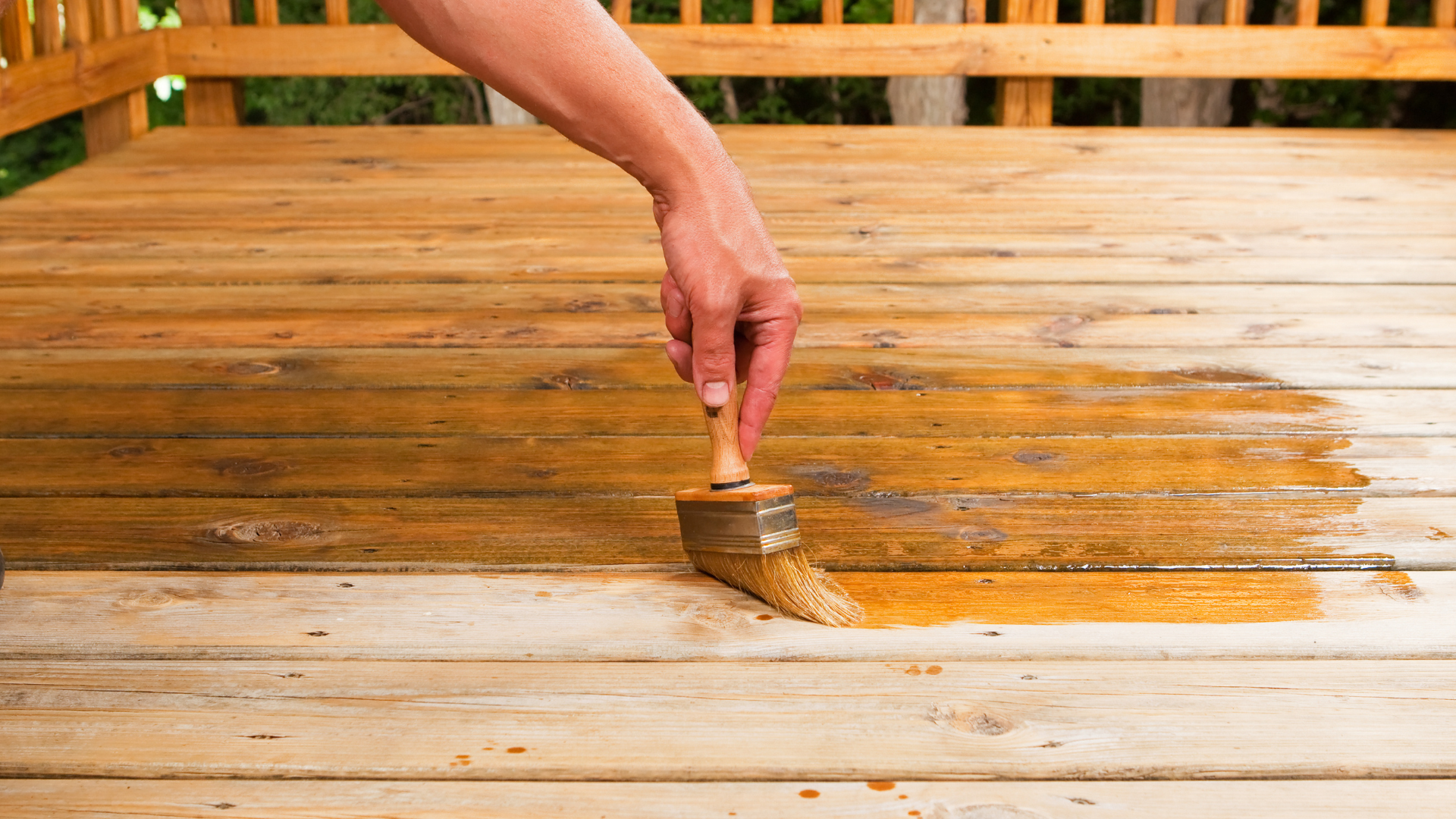
What Timber and Brush Applies on CT Shoreline Decks
When Timber and Brush specifies a stain for a deck in Madison, Guilford, Branford, Clinton, or Old Saybrook, the product recommendation is driven by the wood species, the prior finish history, and the specific exposure conditions on the property, not by what is fastest to apply or what has the best name recognition.
For penetrating deck stains, Timber and Brush uses premium-grade water-based penetrating formulas with solid pigment loads appropriate for the level of UV and moisture protection required on Connecticut Shoreline properties. Semi-transparent stains preserve more of the natural wood appearance but require more frequent refinishing. Solid and semi-solid stains provide stronger UV and moisture protection and extend refinishing intervals on high-exposure properties.
For painted decks or surfaces where paint is the right specification, Timber and Brush uses Benjamin Moore Aura and Sherwin Williams Emerald, the same products specified on every exterior painting job across the Shoreline service area. On a CT Shoreline deck, labor cost substantially exceeds product cost, and applying a budget product to reduce material expense produces a finish that fails ahead of schedule on a surface that is already under more stress than an inland deck.
Every deck job begins with a board-by-board assessment of the wood condition. Soft, spongy, or punky boards are not candidates for refinishing. They are candidates for deck board replacement before any finish goes on. Applying stain or paint over a compromised board produces a finish that looks intact at application and fails within a season as the deteriorating wood below it shifts and moves. Timber and Brush addresses the board condition before the product decision.
For decks where railing posts, balusters, or structural members are showing soft wood or failing joints, deck railing repair is completed as part of the same project before any finish is applied.
Preparation Is What Determines How Long Either Finish Lasts
The most consistent predictor of how long a deck finish lasts on a Connecticut Shoreline property is not whether paint or stain was chosen. It is the condition of the wood at the time of application and the quality of the surface preparation before the product goes on.
A penetrating stain applied to a clean, dry, properly prepared deck surface on sound boards will perform for three to five years in CT Shoreline conditions before refinishing is needed. The same stain applied over a dirty, wet, or partially weathered surface may begin to look tired within a season.
A paint film applied over properly stripped, sanded, and primed deck boards with sound wood beneath will perform for five to seven years in CT Shoreline conditions before repainting is warranted. The same paint applied over inadequately prepared wood or over existing stain without proper stripping will begin to peel within one to two seasons, and the peeling will expose the wood to the trapped moisture situation described above.
Timber and Brush does not skip preparation steps to reduce job time. Every deck receives thorough cleaning, inspection, any necessary board or railing repair, and the surface preparation appropriate to the product being applied before any stain or paint is touched. That sequence is what produces finishes that hold on Connecticut Shoreline properties and what distinguishes a properly done deck job from one that looks the same on day one but performs very differently by year two.
For related context on how the same coastal conditions affect door and trim finishes on CT Shoreline homes, the Timber and Brush article on why front doors take more sun and salt exposure than any other painted surface explains the same mechanisms in the context of vertical exterior surfaces.
If your deck in Madison, Guilford, Branford, Clinton, or Old Saybrook is due for refinishing or is showing early signs of peeling, soft boards, or finish failure, Timber and Brush provides free on-site assessments that evaluate the wood condition, the prior finish history, and the right product for your specific deck before any work begins.
Deck Painting and Staining | Deck Board Replacement | Deck Railing Repair | Exterior Painting Services | Caulking and Sealing | Contact Timber and Brush