
Why Front Doors on CT Shoreline Homes Take More Sun and Salt Exposure Than Any Other Painted Surface
For Madison, Guilford, Branford, and Old Saybrook homes, where Connecticut's 48 inches of annual rainfall combined with salt air exposure on coastal properties accelerates wood moisture cycling, these signs tend to appear sooner and progress faster than they would on an inland property in a drier climate.
When Repair Is the Right Call
Repair makes sense when:
Most homeowners on the Connecticut Shoreline notice the front door before they notice anything else going wrong with the exterior. The paint starts to fade, then chalk, then peel. The wood at the bottom rail or around the threshold goes soft. The finish that looked sharp two or three years ago looks like it has been out there for a decade.
It has not been neglected. The conditions did that.
A front door on a home in Madison, Guilford, Branford, Clinton, or Old Saybrook faces a combination of exposures that no other painted surface on the same house experiences simultaneously. It is south or west facing on most properties, which means it absorbs peak UV from mid-morning through late afternoon. It sits inches above a threshold, which means it takes moisture from below. It faces the street, which on shoreline properties means it catches prevailing onshore winds carrying airborne salt particles from Long Island Sound. And unlike a painted clapboard run that has adjacent boards to absorb and distribute some of that stress, a front door is a single surface taking the full load of every condition at once.
Timber and Brush is an exterior wood repair and painting specialist based in Madison, CT, working across the Connecticut Shoreline. Door refinishing is one of the most consistent requests the team receives, and the reason is always the same: the door failed faster than the homeowner expected. This is why.
What Coastal Air Actually Does to a Painted Wood Door
Salt air is not a background condition on Connecticut Shoreline properties. It is an active degradation mechanism operating on every exposed surface every day.
Research published by the National Institute of Standards and Technology documents that increased temperature and humidity in coastal areas accelerate the deterioration of materials at measurably higher rates than inland environments. The same electrochemical processes that affect structural materials affect organic coatings on wood. Salt particles carried inland from Long Island Sound on prevailing winds settle on exterior surfaces and begin doing specific things to paint film over time.
Salt is hygroscopic. It pulls moisture from the surrounding air and holds it against the surface it has settled on. On a painted wood door, that sustained moisture contact works against adhesion between the paint film and the substrate. As the bond weakens, water finds its way behind the paint. When Connecticut temperatures drop and that moisture freezes, it expands. The film lifts. The cycle repeats through every freeze-thaw event through the winter, which on the Connecticut Shoreline occurs repeatedly from November through March.
On top of the salt mechanism, UV radiation from direct sun exposure breaks down the pigments and binders in exterior paint independently of what salt is doing. As the NOAA Connecticut State Climate Summary documents, Connecticut's climate is characterized by highly variable weather patterns and abundant precipitation throughout the year, with the greatest number of hot days occurring over the most recent decades. More hours of intense summer sun, combined with the salt-laden coastal air, creates a compounding degradation environment that inland paint schedules simply do not account for.
The result on a south or west-facing front door in Madison, Guilford, Branford, or Old Saybrook is a surface that loses its finish protection measurably faster than the rest of the house and faster than any manufacturer's expected repaint cycle suggests.
Why Doors Fail Faster Than Siding or Trim on the Same Property
A reasonable question is why the front door shows wear before the clapboard siding or the trim on the same house. The answer is the combination of four conditions that converge on a door specifically.
Orientation.
Most front doors on Connecticut Shoreline homes face south or southwest, which is the orientation that receives the highest cumulative UV hours through the day and the direction that catches prevailing onshore winds from Long Island Sound most directly. A north-facing clapboard run on the same house receives a fraction of that UV exposure.
Thermal cycling.
A door is a solid panel, typically wood or wood composite, that absorbs heat in direct sun and then releases it as evening temperatures drop. On a summer day in Madison or Guilford, a dark front door in direct afternoon sun can reach surface temperatures significantly above the air temperature. That expansion and contraction cycle, repeated daily through the summer and combined with freeze-thaw cycles through the winter, works the paint film at every seam and joint.
Moisture exposure from below.
The bottom rail of a door and the threshold beneath it are among the most consistently wet surfaces on any house. Rain blows in from the street, water pools on the threshold and wicks into the wood grain at the base of the door, and the ground-level exposure means moisture is present from both above and below. On Shoreline properties in Clinton, Westbrook, and Old Saybrook where nor'easters drive rain horizontally across the approach, this moisture load on the lower door panel is substantial.
No adjacent surface to absorb stress.
When paint fails on a clapboard run, the neighboring boards provide some continuity. A front door is a single panel standing alone. The full force of UV, salt, heat cycling, and moisture converges on that one surface with nothing adjacent to share the load.
| Exterior surface | UV exposure | Salt air load | Moisture exposure | Thermal cycling |
|---|---|---|---|---|
| Front door (south or west facing) | High, direct, daily | High, prevailing wind orientation | High, threshold and rain exposure from ground level | High, solid panel absorbs heat directly |
| North or east facing clapboard | Low to moderate | Moderate | Moderate | Lower, no direct sun |
| Soffit | Very low | Moderate | Low | Low |
| Rear deck boards | Moderate | Lower if sheltered | High from precipitation | Moderate |
| Garage door (south facing) | High | High | Moderate | High, large panel area |
Garage Doors Face the Same Conditions at Larger Scale
Garage doors on Connecticut Shoreline properties face a version of the same problem, amplified by scale.
A two-car garage door is a much larger painted panel than a front door, which means more total surface area exposed to direct sun and prevailing winds. Most garage doors on Shoreline homes in Madison, Guilford, and Branford face the street, which on these properties typically means a southwest to south orientation. Like front doors, they sit close to grade level, which means the bottom sections take direct moisture exposure from rain and snowmelt.
Wood and wood composite garage doors on older Shoreline properties are particularly vulnerable because the panel construction creates horizontal seams where water can infiltrate and where paint adhesion is most likely to fail first. When paint lifts at a seam and water reaches the wood below, the deterioration moves faster than it would on a protected flat panel.
Timber and Brush handles front door and garage door painting as a distinct service across Madison, Guilford, Branford, Clinton, and Old Saybrook precisely because these surfaces require a preparation and product approach that differs from general exterior painting. The prep requirements are specific to the surface geometry, the product selection matters more than it does on a protected soffit run, and the frame and threshold condition underneath the paint needs to be assessed before any coating goes on.
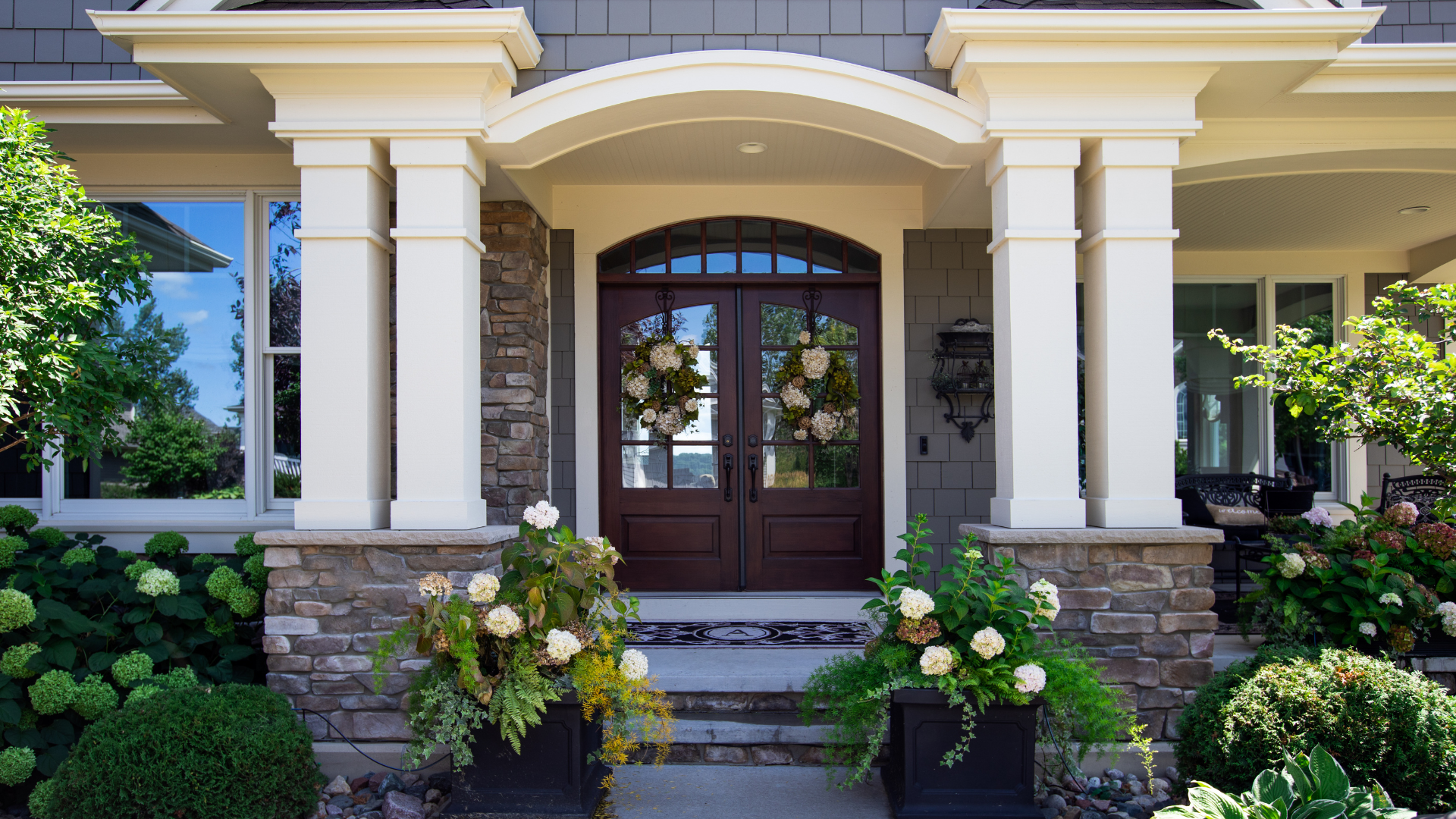
What Proper Door Refinishing Actually Involves
A front door refinishing job done correctly is not a coat of paint brushed over whatever is on the door now. It is a multi-step process that addresses the surface condition, the adhesion problem, and the specific exposure challenges the door faces.
Surface assessment first.
Before any prep work starts, Timber and Brush assesses the door and the frame for wood condition. A door that has been through multiple paint cycles on a Connecticut Shoreline property may have soft wood at the bottom rail, a frame with rot at the threshold, or casing that is separating at the corners. Painting over those conditions produces a finish that looks right for a season and then fails from underneath. The wood condition determines what the job actually involves. For frames with rot, door frame repair is completed before any paint goes on.
Complete stripping or thorough mechanical prep.
A door that has accumulated multiple paint layers over years of Shoreline exposure needs the old coating addressed before new paint adheres reliably. Depending on the condition, that means mechanical stripping or thorough sanding back to a sound surface. Painting over a chalked or partially delaminated existing coat is the most common reason door refinishing fails within a year or two.
Priming with the right product.
A bare or stripped wood door on a coastal property needs a primer selected for adhesion and moisture resistance, not a general-purpose primer that works on protected interior trim. The primer coat is what connects the substrate to the topcoat and what prevents moisture infiltration at the surface. Shortcuts at this stage show up as peeling within twelve to eighteen months.
Premium topcoat products.
Timber and Brush uses Benjamin Moore Aura and Sherwin Williams Emerald on door refinishing work. These are not the least expensive products available. They are the products that perform in Connecticut Shoreline conditions where cheaper paint fails ahead of schedule. Labor cost dwarfs material cost on any door job. Using a premium product adds a fraction to the total cost and meaningfully extends the service life of the finish.
Caulking at joints and seams.
Every seam around the door frame, every joint where trim meets siding, and every gap at the threshold needs proper caulking as part of the finishing process. Caulk failures at these locations are the primary entry point for moisture that undermines paint adhesion from below. Timber and Brush handles caulking and sealing as part of every door refinishing project.
How Long a Properly Refinished Door Should Last on a Shoreline Property
A front door on a Connecticut Shoreline property in Madison, Guilford, Branford, or Old Saybrook that has been properly prepped, primed with the right product, and finished with Benjamin Moore Aura or Sherwin Williams Emerald should hold its finish for five to seven years under normal conditions. That is meaningfully shorter than the same product might last on a protected surface on an inland property, but it reflects the reality of what direct sun, salt air, and freeze-thaw cycling do to any exterior coating over time.
The specific factors that determine where a door falls within that range include its orientation on the property, how much direct afternoon sun it receives, whether the threshold drains properly or allows water to pool, and whether the caulking at joints and seams is maintained between paint cycles.
A door that is showing early signs of surface chalking or color shift has not failed yet. Addressing it at that stage, before paint begins to lift or wood at the threshold goes soft, is significantly less expensive than waiting until the frame and casing need repair before the door can be painted. Timber and Brush sees both situations regularly on properties throughout the Shoreline corridor.
For context on how the same coastal conditions affect other exterior wood elements on Shoreline properties, the Timber and Brush approach to exterior painting describes how prep and product selection differ for different surfaces and exposure conditions.
If your front door or garage door on a Connecticut Shoreline property is showing signs of fading, chalking, peeling, or soft wood at the bottom rail, Timber and Brush provides free on-site assessments with written pricing before any work begins. The same crew that assesses the wood condition is the crew that does the repair and applies the paint.
Front Door and Garage Door Painting | Door Frame Repair | Caulking and Sealing | Exterior Painting Services | Contact Timber and Brush