
Fence Paint vs Fence Stain for CT Shoreline Homes: Which Holds Up Better Against Salt Air and UV
For Madison, Guilford, Branford, and Old Saybrook homes, where Connecticut's 48 inches of annual rainfall combined with salt air exposure on coastal properties accelerates wood moisture cycling, these signs tend to appear sooner and progress faster than they would on an inland property in a drier climate.
When Repair Is the Right Call
Repair makes sense when:
A fence on a Connecticut Shoreline property takes punishment that most homeowners underestimate. It stands in the open, fully exposed to salt air off Long Island Sound, direct UV through the summer, driving rain from nor'easters, and the freeze-thaw cycling that runs from November through March. It has no roof over it. No overhang to shelter it. It absorbs everything the climate delivers, on both faces, from every direction.
That exposure is why the paint-versus-stain decision matters more on a fence than on almost any other exterior surface. The wrong product fails early, often within a season or two, and the failure is not just cosmetic. A fence finish that lets moisture into the wood or traps it behind a cracking film is a fence that is actively deteriorating while it looks like it just needs a fresh coat.
Timber and Brush is an exterior wood specialist based in Madison, CT, providing fence painting and staining across the Connecticut Shoreline. The team finishes fences on Shoreline properties regularly and sees the same failure patterns over and over. This is the comparison that determines which product belongs on a specific fence and why.
How Each Product Protects Wood Differently
The paint-versus-stain distinction on a fence is the same fundamental mechanism as on a deck, but the consequences are amplified because a fence has no shelter from any direction.
Stain penetrates the wood fibers.
A penetrating fence stain carries pigment, UV inhibitors, and water repellents into the cellular structure of the wood rather than sitting on top. The wood can expand and contract freely through temperature and moisture changes because the finish is inside the fibers, not forming a skin over them. Stain does not peel because there is no film to detach.
Paint forms a film on the surface.
Paint builds a protective layer on top of the wood. When the film is intact, it blocks moisture and UV effectively. When it cracks, and on a fully exposed fence it will, moisture enters behind the film and becomes trapped between the paint and the wood. That trapped moisture is what drives the rot that fence paint is supposed to prevent.
The USDA Forest Service Forest Products Laboratory states directly that penetrating finishes are recommended for wood surfaces that experience weathering, and that film-forming finishes are prone to trap moisture and fail by peeling. A fence is one of the most weather-exposed wood surfaces on any property, which is why this guidance applies with full force.
Why This Matters More on the CT Shoreline
Every condition that causes a paint film to fail happens faster and more aggressively on a Connecticut Shoreline fence than on an inland one.
| Shoreline condition | What it does to a painted fence | What it does to a stained fence |
|---|---|---|
| Salt air off the Sound | Degrades paint binders, accelerates cracking | Minimal effect, stain is inside the wood |
| Freeze-thaw cycling | Expands trapped moisture, lifts the film | Wood moves, stain moves with it |
| 47 inches of annual rain | Enters every film crack, feeds rot underneath | Sheds water at the fiber level |
| Direct UV, no shelter | Breaks down paint pigment and elasticity | Fades gradually, reapplication is simpler |
| Wind-driven rain, both faces | Reaches every surface, no protected side | Penetration protects from all directions |
The NOAA Connecticut State Climate Summary documents 47.3 inches of annual precipitation with no dry season and increasing extreme rainfall events. A fence finish on a Shoreline property absorbs that constant moisture load from every direction, 365 days a year. A film that cracks in year two has three more years of Connecticut rain entering behind it before most homeowners notice and act.
The Cedar Fence Question
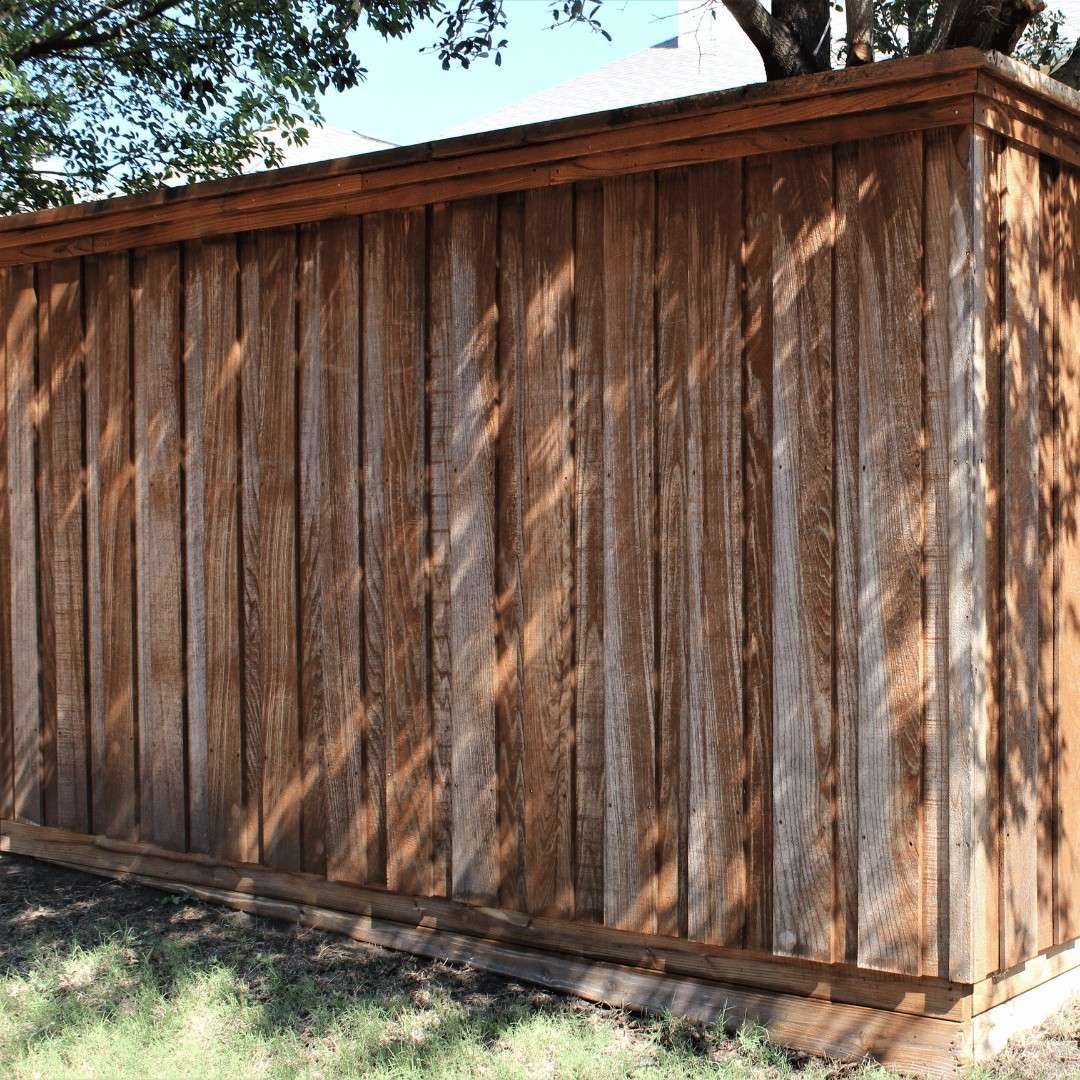
Cedar is the most common fence material on Connecticut Shoreline residential properties, and it has a strong, specific preference for stain over paint.
Cedar's natural oils give it excellent resistance to rot and insects, which is why it is the preferred fence wood in this climate. Those same oils make it a poor candidate for paint adhesion, because the oils resist the bond between the paint film and the wood surface. A painted cedar fence frequently shows adhesion failure, peeling, and flaking earlier than the same paint on a different wood species, not because the paint is bad but because cedar's chemistry works against film adhesion.
Stain, by contrast, works with cedar's natural properties:
- The oil-rich grain absorbs penetrating stain well
- Stain replenishes the UV and moisture protection cedar's natural oils provide
- No adhesion conflict between the product and the wood
- The natural wood grain and character remain visible with semi-transparent stains
For cedar fences on the CT Shoreline, stain is the strong recommendation. Paint on cedar is fighting the wood's own chemistry, and on a fully exposed fence in a coastal environment, that fight produces early failure.
When Fence Paint Is the Right Choice
Paint is not wrong for every fence situation, and there are specific circumstances where it is the more practical option.
- A severely weathered fence where the wood appearance needs hiding. Paint conceals surface damage, graying, and inconsistency that stain cannot mask. If the boards are structurally sound but visually far gone, paint restores a uniform appearance.
- A fence that has been painted for its full life. A fence with an existing paint history and sound adhesion is a reasonable candidate for repainting when it is time. Switching from paint to stain requires full stripping, which on a fence with two faces and hundreds of board feet is a significant labor investment.
- Pressure-treated pine where the homeowner wants a solid, opaque finish. Pressure-treated lumber accepts paint better than cedar and does not have the oil-based adhesion conflict. A quality primer and topcoat on pressure-treated boards can deliver a durable finish.
A fence where the stain has been neglected and the wood has degraded too far for stain to look right. At a certain point of surface degradation, stain no longer produces an attractive result because it reveals rather than conceals the surface condition. Paint becomes the tool that recovers the appearance.
What Reapplication Looks Like for Each
One of the biggest practical differences between paint and stain on a fence shows up not at application but at reapplication, and on a CT Shoreline fence, reapplication arrives sooner than homeowners expect.
| Factor | Stain reapplication | Paint reapplication |
|---|---|---|
| Typical cycle, exposed CT fence | 2 to 3 years on full-sun runs | 3 to 5 years if no peeling |
| Surface prep required | Clean, light sand if needed, reapply | Scrape peeling areas, prime bare spots, repaint |
| What failure looks like | Gradual fading, wood graying | Peeling, cracking, blistering |
| How easy is the recoat | Straightforward, no stripping | Extensive if paint has peeled |
| What happens if you defer | Wood grays, absorbs moisture, but recovers with prep | Trapped moisture rots wood behind the film |
The key difference in that table is the last row. A stained fence that goes past its reapplication window grays and weathers, which is unattractive but reversible with prep and a fresh coat. A painted fence that goes past its window develops peeling that traps moisture and can rot the wood underneath, which means the reapplication becomes a repair job rather than a simple recoat.
Stain fails gracefully. Paint fails destructively. On a fully exposed Shoreline fence, that distinction is the whole argument.
What Timber and Brush Uses on CT Shoreline Fences
Product selection on a Shoreline fence follows the same principle Timber and Brush applies on every exterior project: the product has to match the wood, the exposure, and the conditions, not the price point.
For stained fences, the team uses premium penetrating stains with UV inhibitors and mildewcide appropriate for the coastal moisture environment. Semi-transparent stains preserve the natural cedar grain. Semi-solid and solid stains provide stronger UV protection for fences in full sun with maximum salt exposure. The specific product is matched to the fence's wood type, condition, and exposure during the walkthrough.
For painted fences and surfaces where paint is the right specification, Timber and Brush uses Benjamin Moore Aura or Sherwin Williams Emerald, the same products used on every exterior project across the Shoreline service area. On a fence, where labor cost dwarfs material cost, using a premium product adds a fraction to the total and meaningfully extends how long the finish holds.
Every fence job starts with the same assessment as every other Timber and Brush project: the wood condition is checked before any product goes on. Boards that are soft, split, or rotted do not get finished over. They get addressed first through the wood repair scope so the finish is applied to sound material. The related article on deck paint versus deck stain covers the same penetration-versus-film mechanism on horizontal surfaces, and the exterior painting overview describes the full approach across all exterior surfaces.
If your fence in Madison, Guilford, Branford, Clinton, or Old Saybrook is fading, peeling, graying, or overdue for attention, Timber and Brush provides free on-site assessments that evaluate the wood condition, the existing finish, and the right product for your specific fence before any work begins.
Fence Painting and Staining | Deck Painting and Staining | Exterior Painting Services | Contact Timber & Brush