
Why Coastal Salt Air and Summer UV on the CT Shoreline Accelerate Deck Finish Failure Faster Than Inland Properties
For Madison, Guilford, Branford, and Old Saybrook homes, where Connecticut's 48 inches of annual rainfall combined with salt air exposure on coastal properties accelerates wood moisture cycling, these signs tend to appear sooner and progress faster than they would on an inland property in a drier climate.
When Repair Is the Right Call
Repair makes sense when:
A deck in Madison, Guilford, Branford, or Old Saybrook does not get the same lifespan from its finish that an identical deck fifty miles inland would. Homeowners on the Connecticut Shoreline learn this the expensive way: the stain fades faster, the paint peels sooner, and the finish that looked fresh two summers ago looks like it has been there for five.
This is not a product problem or a contractor problem. It is an environment problem, and understanding the specific mechanisms behind it is what separates a finish that holds for its expected cycle from one that fails ahead of schedule. Salt air, UV intensity reflected off Long Island Sound, freeze-thaw cycling, and year-round moisture are each working against the deck finish independently, and on a Shoreline property they are all working at the same time.
Right now, in the peak of August, CT Shoreline decks are absorbing the most intense UV of the year, and the salt air that has been working on the finish since spring is at its most active. This is the time of year when a finish that is beginning to fail shows it, and the window before fall storms arrive to address it is closing.
Timber and Brush is an exterior wood specialist based in Madison, serving the Connecticut Shoreline. This guide explains what each exposure condition actually does to a deck finish, why the combination matters, and what holds up when the cheap options do not.
What Salt Air Actually Does to a Deck Finish
Salt air is not just a vague "coastal condition." It is a specific, active degradation mechanism that operates on every exposed surface every day on a Connecticut Shoreline property.
Salt particles carried inland from Long Island Sound on prevailing onshore winds settle on the deck surface and stay there between rain events. Those particles are hygroscopic, meaning they pull moisture from the surrounding air and hold it against the surface they have settled on. On a finished deck, that sustained moisture contact attacks the bond between the finish and the wood below.
What the salt does to each finish type:
- On a film finish (paint, solid stain): Salt moisture works against the adhesion of the film. As the bond weakens, moisture gets behind the film. Freeze-thaw cycling then expands that trapped moisture and lifts the film further. The peeling that follows is salt-accelerated adhesion failure.
- On a penetrating stain: Salt has far less effect because there is no surface film to attack. The stain is inside the wood fibers, and salt particles sitting on the surface do not reach it. This is a fundamental reason penetrating stains outperform film finishes on Shoreline decks.
Salt is also a mild abrasive. Wind-driven salt particles scour the surface on exposed decks, which contributes to the granular surface roughness homeowners notice on aging Shoreline finishes.
What UV Does to a Deck Finish on the Shoreline
Every deck takes UV damage from the sun. A CT Shoreline deck takes more, because the water amplifies it.
Long Island Sound reflects UV back up onto the deck surface from below and from the south, which means a south-facing Shoreline deck receives direct UV from above and reflected UV from the water simultaneously. The total UV load on these decks is measurably higher than on an inland deck that receives only direct sun.
UV degrades deck finishes through two specific mechanisms:
- Pigment breakdown. The pigment in a stain or paint absorbs UV to protect the wood beneath. As the pigment breaks down, the wood loses its UV shield, the color fades, and the surface begins to gray.
- Binder degradation. UV breaks down the chemical binders that hold a film finish together. As the binders fail, the film loses elasticity and becomes brittle, which makes it vulnerable to cracking under the thermal movement of the wood.
The USDA Forest Service Forest Products Laboratory documents that UV radiation is one of the primary causes of finish degradation on exterior wood surfaces. On a CT Shoreline deck with reflected UV from the Sound, that degradation is accelerated compared to a property that receives only direct sun exposure.
How Freeze-Thaw and Rain Complete the Cycle
Salt and UV weaken the finish. Freeze-thaw cycling and Connecticut's year-round rainfall complete the failure.
The
NOAA Connecticut State Climate Summary documents 47.3 inches of annual precipitation with no dry season and increasing extreme rainfall events. A deck finish on the Shoreline is under continuous moisture load. Every crack that salt and UV have opened in the finish becomes a pathway for that rain, and every freeze-thaw cycle through the winter expands the trapped moisture and opens the crack further.
| Exposure | What it does to the finish | How it compounds |
|---|---|---|
| Salt air | Degrades adhesion, holds moisture | Weakens the bond UV then breaks |
| UV from sun and water reflection | Breaks down pigment and binders | Creates brittleness salt then cracks |
| Rain, 47 inches per year, no dry season | Enters every opening | Feeds rot behind failed film |
| Freeze-thaw, November through March | Expands trapped water, lifts film | Widens every crack salt and UV started |
These four conditions do not operate in sequence. They operate simultaneously, which is why a CT Shoreline deck finish fails two to three years ahead of the same product on an inland property. The degradation is compounding rather than additive.
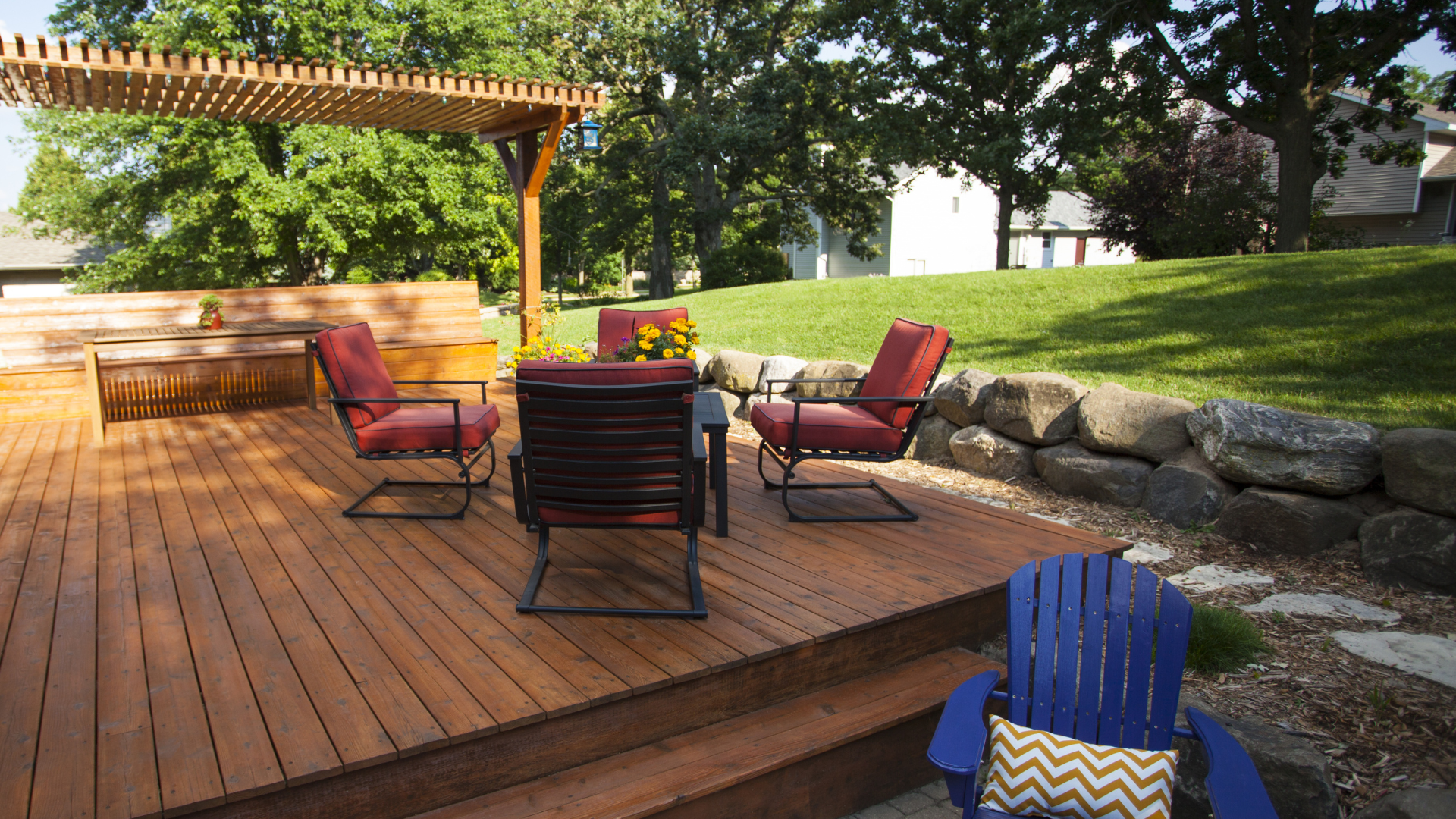
What Actually Holds Up on a CT Shoreline Deck
The product recommendation follows directly from the exposure conditions. A finish that cannot withstand the combination of salt, UV, freeze-thaw, and constant rain does not belong on a Shoreline deck regardless of its price or its brand.
Penetrating stains outperform film finishes in these conditions. They work inside the wood rather than on top of it, which eliminates the adhesion-failure mechanism that salt attacks and the film-cracking mechanism that freeze-thaw exploits. They require more frequent reapplication, typically every two to three years on heavily exposed Shoreline runs, but the reapplication is straightforward because there is no peeling to scrape and no film to strip.
Premium products outperform budget products by a meaningful margin. Timber and Brush uses Benjamin Moore Aura and Sherwin Williams Emerald on deck projects precisely because the binder technology in these products resists UV and moisture degradation longer than economy products. On a deck where labor cost substantially exceeds material cost, the price difference between a premium product and a budget one is small relative to the total job, but the performance difference is measured in years.
Preparation determines the outcome more than product choice. A premium stain on a properly cleaned, sanded, and prepped deck surface bonds to sound wood and performs to its specification. The same stain on a dirty, wet, or degraded surface fails within a season regardless of what it cost. Timber and Brush does not skip prep steps, which is the single biggest reason the finishes they apply hold through Connecticut Shoreline conditions.
For the deeper comparison of how paint and stain perform differently on CT Shoreline decks, the article on deck paint versus deck stain covers the film-versus-penetration decision in full. For decks where the boards themselves are showing signs of failure beneath the finish, the deck board replacement service addresses the wood condition before any new finish goes on.
The Maintenance Cycle on a Shoreline Deck
Understanding the realistic maintenance timeline prevents the frustration of expecting an inland schedule from a coastal property.
| Deck exposure level | Stain reapplication cycle | What drives the timing |
|---|---|---|
| Full south exposure, waterfront | 2 years | Maximum UV reflection and salt |
| South or west exposure, not waterfront | 2 to 3 years | Direct UV and salt without water reflection |
| Sheltered or north-facing sections | 3 to 4 years | Lower UV, some salt protection |
| Covered porch or protected areas | 4 to 5 years | Minimal direct exposure |
The water-bead test remains the simplest way to check: sprinkle water on the boards, and if it soaks in instead of beading up, the finish has worn through regardless of how long it has been since the last application. The article on 6 signs your CT Shoreline deck is failing before you see the wood crack covers the full set of early warning signs.
Timber and Brush's deck painting and staining service covers the full prep, repair, and refinishing process across Madison, Guilford, Branford, Clinton, and Old Saybrook.
If your deck in Madison, Guilford, Branford, Clinton, or Old Saybrook is fading, peeling, graying, or absorbing water instead of shedding it, the finish has lost its protection. Timber and Brush can assess the wood, the existing finish, and the exposure conditions and apply a product that actually holds up in CT Shoreline conditions.
Deck Painting and Staining | Deck Board Replacement | Deck Railing Repair | Exterior Painting | Contact Timber & Brush