
Repairing Damaged Fascia vs Full Fascia Board Replacement: How Timber and Brush Makes the Call
The fascia board running along the edge of a Madison, Guilford, or Branford roofline does more work than most homeowners give it credit for. It supports the gutters, covers the exposed ends of the roof rafters, and forms the last line of defense against moisture reaching the structure behind it. When that board starts showing damage, soft spots, peeling paint, discoloration, a soft give when you press on it, the question that follows is rarely simple: does this section get repaired, or does the whole board need to come off?
The honest answer is that it depends, and getting that decision wrong in either direction costs money. Replacing a board that only needed a targeted repair is an unnecessary expense. Repairing a board that has rot extending well beyond what is visible from the outside produces a fix that fails again within a year or two, after which the homeowner pays for the repair and the eventual replacement anyway.
This guide explains exactly how Timber and Brush evaluates fascia damage on Connecticut shoreline homes, what factors push the decision toward repair versus full replacement, and what each option actually involves once the call is made.
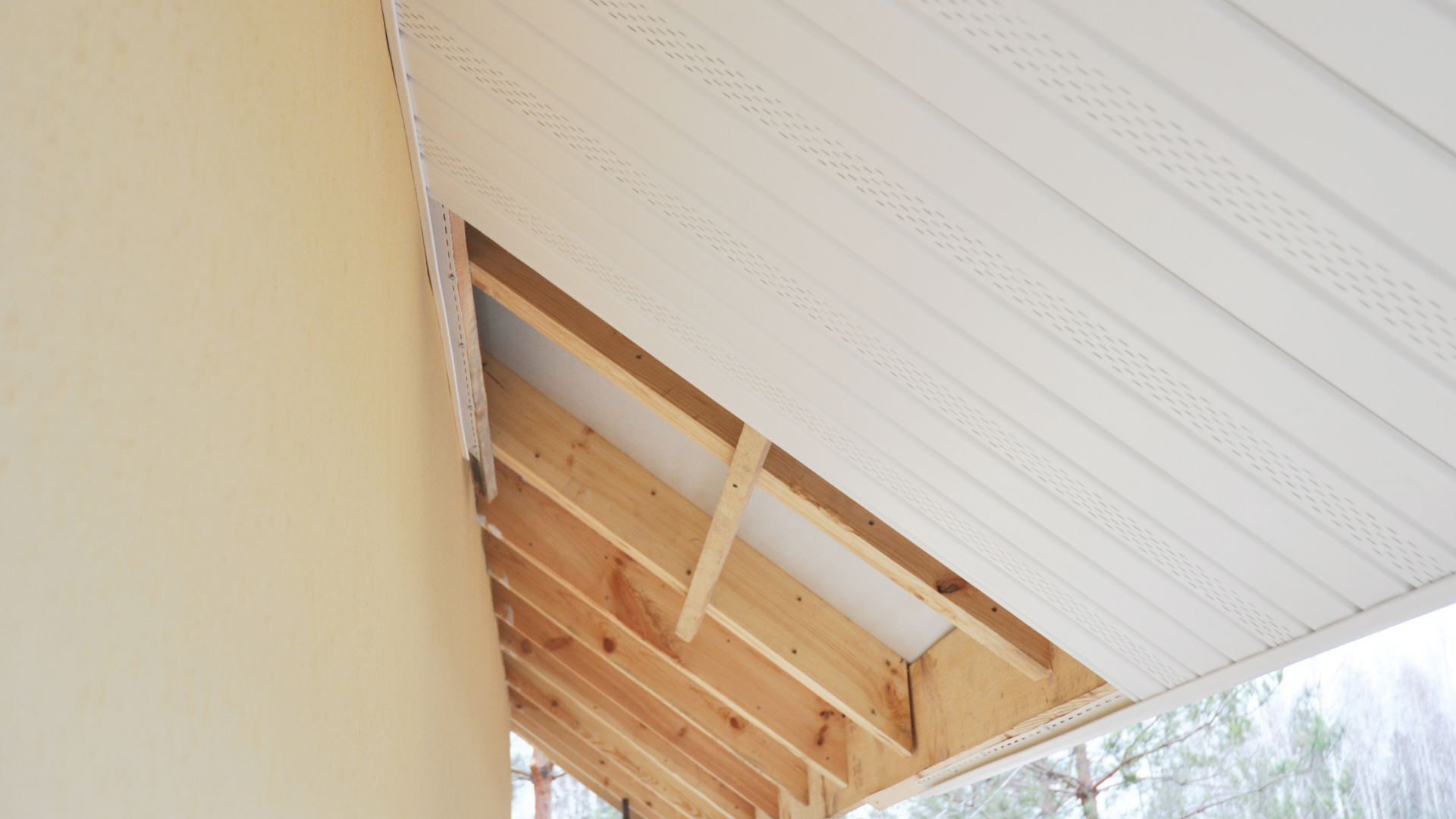
What Fascia Damage Looks Like Before It Becomes Obvious
Fascia damage on Connecticut shoreline properties almost always starts the same way: with water. The board sits directly behind the gutter, which means any gutter overflow, leak, or backup repeatedly wets the same section of wood. Over time, that moisture breaks down the wood fibers, and the visible signs follow in a fairly predictable sequence.
The early signs that warrant inspection:
- Peeling or bubbling paint: This is almost always the first visible sign, and it indicates that moisture is getting behind the paint film, whether from gutter overflow against the board or from interior humidity pushing outward through the wood
- Discoloration or dark staining: Water stains appearing as dark streaks indicate ongoing moisture contact, even before the wood itself has begun to soften
- A soft give when pressed: Healthy fascia feels solid and firm under light pressure. Wood that has begun to rot gives way, sinks slightly, or feels spongy, even when the surface paint still looks intact
- Gutters that are sagging or pulling away from the roofline: This is one of the most reliable indirect signs of fascia damage, because gutter hangers need solid wood to grip, and a gutter pulling loose from the fascia is telling you the wood behind it can no longer hold the fasteners securely
- Visible gaps, cracks, or splits: These compromise the structural integrity of the board directly and are visible from ground level on more advanced damage
For Madison, Guilford, Branford, and Old Saybrook homes, where Connecticut's 48 inches of annual rainfall combined with salt air exposure on coastal properties accelerates wood moisture cycling, these signs tend to appear sooner and progress faster than they would on an inland property in a drier climate.
The Inspection: What Determines Repair vs Replacement
Pressing on a board from the ground tells you something is wrong. It does not tell you how far the damage extends, and that extent is the single most important factor in the repair versus replacement decision.
What a Timber and Brush fascia assessment includes:
- Probing at multiple points along each affected board: Using a screwdriver or awl to test wood density at several locations, not just the spot that shows visible damage. Rot frequently extends further along the board than the visible surface symptoms suggest, particularly when the damage originated behind the gutter where it cannot be seen without removing the gutter section.
- Checking behind the gutter: Significant fascia damage often hides directly behind the gutter, in the zone that is never visible during a normal ground-level inspection. This is one of the most common places where damage is discovered to be more extensive than what prompted the original service call.
- Assessing the percentage of the board affected: This is the number that drives the decision more than any other single factor. According to fascia repair industry guidance, when rot affects less than 20 to 30 percent of an individual board's length and the surrounding structure remains sound, targeted repair is typically the appropriate and cost-effective solution. When damage extends beyond that threshold, or when it has caused structural compromise such as gutters pulling away from the board, full board replacement becomes the more effective and longer-lasting solution.
- Evaluating the condition of adjacent boards: Fascia damage often does not stop at a single board. Moisture that has compromised one section frequently affects the boards on either side, particularly at the joints where boards meet, which is itself a common entry point for water.
- Inspecting the soffit and rafter tails behind the fascia: Water that has been getting past damaged fascia for an extended period frequently reaches the soffit and the rafter tails behind it. A fascia repair or replacement that does not account for soffit or rafter damage is incomplete, regardless of how well the fascia work itself is executed.
When Repair Is the Right Call
Targeted repair is the correct choice when damage is localized, the surrounding wood is structurally sound, and the cause of the damage, almost always a gutter or moisture issue, can be corrected as part of the same project.
Repair makes sense when:
- Damage is isolated to a small section, generally under 20 to 30 percent of the board's length, with solid wood on either side of the damaged area
- The surrounding structure shows no signs of compromise: No sagging gutters at that location, no soft spots in the adjacent boards, no evidence of moisture having traveled into the soffit or rafter tails
- The damage is recent and has not had years to progress: Fascia that has been wet for one season looks different under probing than fascia that has been compromised for five years, even when the surface symptoms appear similar
- The cause of the moisture exposure can be eliminated: If the damage is being driven by a gutter that is overflowing, sagging, or leaking at that exact location, repairing the fascia without correcting the gutter issue produces a repair that fails again. A proper repair project addresses both.
What a quality fascia repair involves:
For minor, isolated rot, the damaged wood is fully removed using a chisel or utility knife until only solid material remains. The cleaned area receives an application of wood hardener, which penetrates the surrounding fibers and reinforces them against further decay, followed by exterior-grade epoxy filler to rebuild the wood profile. Once cured, the repaired section is sanded smooth, primed, and painted to match the surrounding fascia.
For damage that extends beyond surface-level filling but remains within a manageable section, partial board replacement removes only the affected portion of the board while preserving the sound sections on either side, which reduces both material cost and labor time compared to replacing the entire board length.
A properly executed repair on structurally sound fascia, paired with whatever gutter or moisture correction is needed to address the underlying cause, can perform reliably for 8 to 12 years with proper maintenance and periodic repainting. A repair performed on wood that was already more compromised than the surface indicated, without correcting the underlying moisture source, tends to fail again within 2 to 4 years.
When Full Replacement Is the Right Call
Full board replacement becomes the correct choice when damage is widespread, when the structural integrity of the board has been compromised, or when the pattern of damage indicates the board has reached the end of its serviceable life regardless of how localized any single damaged section appears.
Replacement makes sense when:
- Rot affects more than 20 to 30 percent of the board's length: At this threshold, the cost and reliability of targeted repair work no longer compares favorably to clean replacement, and according to fascia industry guidance, this is the point at which replacement consistently delivers better long-term value than continued repair.
- The board has caused structural compromise: Sagging gutters, gutter hangers that have pulled out of the wood, or visible separation between the fascia and the roofline all indicate that the board's structural capacity has been exceeded, not just its cosmetic condition.
- Multiple sections along the same run show damage: When damage is distributed across several locations rather than concentrated in one isolated spot, the underlying moisture exposure has likely affected the entire board even where surface symptoms have not yet appeared. Replacing the full run prevents the recurring cycle of finding new damaged sections every year or two.
- The board is old and has a history of repeated repairs: Wood fascia in Connecticut's climate has a typical service life of 15 to 20 years with proper maintenance. A board that is already at or past that age and is showing damage is a board where continued repair is buying shorter and shorter windows before the next problem appears.
- There is an opportunity to upgrade material during the work: When replacement is already warranted, it is the natural point to evaluate whether the new fascia should be installed in a more durable, lower-maintenance material than the original wood, a decision covered in detail below.
What full fascia replacement involves:
The gutter system is detached from the affected section to allow access to the fascia without damaging the gutter itself. The damaged board is removed, taking care to inspect the rafter tails and roof sheathing behind it for any moisture damage that needs to be addressed before the new fascia goes on, since covering compromised structural wood with a new fascia board does not solve the underlying problem. The new board is installed, properly sealed at every joint and end cut, primed, and painted, or installed pre-finished depending on the material selected. The gutter system is then reattached, with hanger spacing and fastening verified to meet current standards rather than simply reinstalled in the same positions as before.
What Replacement Costs on Connecticut Shoreline Homes
Fascia board replacement typically runs $6 to $25 per linear foot depending on material, with most installed projects falling between $1,050 and $3,300 for an average-sized home, according to multiple verified cost guides. Wood remains the most economical material upfront at roughly $5 to $10 per linear foot installed, while composite and aluminum-clad options run higher but offer significantly better moisture resistance and lower long-term maintenance, a factor that carries particular weight on Connecticut shoreline properties where salt air and consistent rainfall accelerate wood deterioration faster than in inland climates.
Targeted repair work, when the damage qualifies for it, costs considerably less than full replacement, typically a fraction of what replacing the full board run would run, which is exactly why an accurate assessment of damage extent before committing to either approach protects the homeowner's budget in both directions.
The Material Question: What to Install When Replacement Is Warranted
When fascia replacement is the right call, it is also the moment to decide whether to replace like for like with wood, or to upgrade to a material better suited to Connecticut shoreline conditions.
Wood: The traditional choice and the most economical upfront. Requires regular painting or sealing, typically every 3 to 5 years, to prevent the same rot cycle from beginning again. On coastal properties in Branford, Old Saybrook, and Clinton facing sustained salt air exposure, wood fascia without a disciplined maintenance schedule tends to show damage again sooner than the same material would inland.
Composite and aluminum-clad fascia: Significantly more resistant to moisture and rot, and largely maintenance-free compared to wood. The higher upfront material cost is frequently offset over time by the elimination of the repaint and reseal cycle that wood requires, and for homeowners who have already gone through one or more fascia repair cycles on the same section of roofline, switching material at the point of replacement breaks that recurring expense pattern.
Timber and Brush discusses material options as part of every fascia replacement assessment, weighing the specific exposure conditions of the property, whether it is a coastal lot facing direct salt air or a more sheltered inland location, against the homeowner's priorities for upfront cost versus long-term maintenance.
Why Getting the Call Right Matters Beyond the Fascia Itself
Fascia condition is not an isolated cosmetic concern. It directly affects gutter stability, since gutters mounted to soft or compromised fascia pull away from the roofline and produce uncontrolled water discharge that can erode landscaping, overwhelm foundation drainage, and contribute to basement moisture problems. It affects roof edge protection, since exposed rafter tails behind failed fascia are vulnerable to ongoing moisture and pest intrusion that spreads inward into the structure over time. And it affects the soffit system behind the fascia, where water that has been traveling past compromised boards for an extended period can saturate insulation and rot the soffit panels themselves.
Getting the repair versus replacement decision right the first time, based on an accurate assessment of how far the damage actually extends rather than a guess from ground level, is what prevents a manageable fascia issue from becoming a multi-component exterior project.
Timber and Brush: Fascia Assessment and Repair on the CT Shoreline
Timber and Brush serves Madison, Guilford, Branford, Clinton, Old Saybrook, and the surrounding Connecticut shoreline communities with fascia and soffit repair, deck repair and staining, and exterior wood restoration. Every fascia assessment includes thorough probing at multiple points, inspection behind the gutter line, and an honest recommendation on whether the specific damage calls for targeted repair or full board replacement, along with a clear explanation of why before any work begins.